
On this page
- The one-line answer
- What actually wears in a JF015E variator
- The 29-tooth versus 30-tooth primary pulley
- Inspecting the belt
- Inspecting the cone surfaces
- Three kinds of metal, three different repairs
- Why the belt and cone are one part, not two
- Bearings and the rear cover
- Fluid
- When a valve body will not save it
- What to send us
- Sources and frequently asked questions
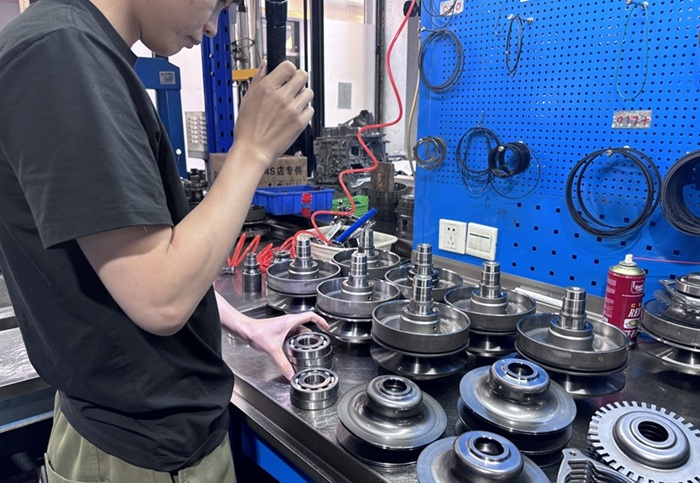
Most JF015E repairs that come back a second time were not caused by a bad part. They were caused by replacing one worn surface and leaving its partner in place, or by ordering a pulley set without checking the tooth count first. This page is the inspection sequence we run on the bench, in the order that finds the real problem fastest.
What this page gives you
- The four inspections that decide belt and pulley condition, and what each sign actually means.
- The 29-tooth versus 30-tooth rule — the single check that prevents a wrong pulley set.
- How to read three different kinds of metal in the fluid, because they point at three different repairs.
- Why the belt and cone must be treated as one wear pair, not two parts.
- When a valve body will not save the unit, so you stop spending on the wrong end of the transmission.
01The one-line answer
If you only read one line: drain the fluid first and look at it — it answers most of the question before the unit is apart. Clean fluid with a judder complaint points at hydraulics; fluid with fine grey paste points at belt and cone wear; fluid with visible glitter or chips means the variator has already shed material and the pulley set, belt and possibly the cooler are all in scope. Then, before ordering, confirm the tooth count of the primary pulley on the unit in front of you.
02What actually wears in a JF015E variator
Six things, and they fail at different mileages:
| Component | What it does | How it presents |
|---|---|---|
| Belt elements | Transmit torque through the cones by pushing against each other | Judder under load, ratio codes, metallic paste in the fluid |
| Ring packs | Hold the element stack together and carry the tension | Belt rattle, broken rings, sudden loss of drive |
| Cone surface | Provides the friction path to the belt edges | Scoring, polishing, heat marks — slip that no valve body fixes |
| Pulley bearings | Support the primary and secondary shafts | Whine or rumble that changes with ratio, not with engine speed |
| Rear cover / bearing seat | Locates the secondary side and the belt run | End-float and seal weep once worn |
| Fluid itself | Works the hydraulic pressure and carries the heat away | Varnish, dark colour, burnt smell, wrong specification |
The important structural point: on this transmission the belt pushes rather than pulls. The elements are in compression around the cones, which is why element face condition and cone surface finish are so tightly coupled — damage to one imprints on the other.
03The 29-tooth versus 30-tooth primary pulley
This is the check that costs the most when it is skipped. The JF015E primary pulley is catalogued in two versions, and the pulley-and-belt sets are supplied to match:
| Set | Primary pulley | Part number | Note |
|---|---|---|---|
| Set with rear cover | 29-tooth | 31214-3JX9B | The international-stream reference set. |
| Set with rear cover | 30-tooth | 31214-X429D | The US-stream reference set. |
A 29-tooth set and a 30-tooth set belong to different builds of the same transmission. The belt, the cone geometry and the ratio calibration follow the tooth count. They are not a "slightly different version" — they are the wrong parts for the unit if you guess. Count the teeth on the pulley you are removing, or photograph it so the count can be read, before anything is ordered. The same applies to the belt itself, which is catalogued as 901072 and 901068.
04Inspecting the belt
With the belt out and clean, look at it in this order. Each sign maps to a different cause, and none of them are matters of opinion:
| What you see | What it means | Action |
|---|---|---|
| Element faces with a bright, uniform contact band | Normal wear pattern | Measure and compare against the set it came from; do not reuse the belt with a new cone surface. |
| Localised bright spots or flattened elements | Point loading — usually where the belt has been running at one ratio under load | Treat cone surface as suspect too. |
| Dark bands, bluing or heat discolouration on elements | Overheating, typically from low pressure rather than from heavy use | Investigate the hydraulic side as well, not only the variator. |
| Stepped or lipped element edges | Elements have worn into each other | Replace the set. A belt in this state is shedding material into the fluid. |
| Broken, loose or distorted rings | Ring pack failure | Full set, and inspect the cones for impact damage. |
| Rust or corrosion on contact faces | Water or long storage in the wrong fluid | Full set, plus a fluid and cooler check. |
05Inspecting the cone surfaces
The cone faces are the friction partners of the belt edges. They should show a fine, even, matte working band. Anything else is a decision point:
| Cone surface condition | Reading | Can it be reused? |
|---|---|---|
| Fine uniform matte band, no ridges under a fingernail | Serviceable wear pattern | Only with a belt that matches its measured condition. |
| Polished or glazed — shiny, mirror-like track | Loss of surface roughness; the belt cannot grip | No. This is the classic "new belt still slips" cause. |
| Scored or grooved — rings you can feel | Cone material has been removed by debris or element damage | No. Replace the pulley set. |
| Heat-marked — bluing or hot spots | Localised overheating, usually hydraulic in origin | No. Investigate pressure control before reassembly. |
| Stepped wear at the extreme ratio positions | The car spent its life at one ratio, often stop-start use | No. And expect belt wear to match. |
Exact wear limits are dimensional and must come from the service data for the specific build — we do not publish a limit we have not verified against a specification sheet, because a wrong number here produces a wrong decision and a second repair. Condition is judged by the physical signs above and by measurement against that data.
06Three kinds of metal, three different repairs
The drained fluid is the cheapest diagnostic you will ever run on this transmission. Read it in this order:
| Signature | Looks like | What it points to |
|---|---|---|
| Fine grey paste on the magnet, smooth on the finger | Normal, gradual belt and cone wear | Variator service is coming. Check belt and cones together. |
| Glitter — individual bright specks | Material being actively shed | The variator has already lost surface. Pulley set and belt are both in scope, and so is the cooler. |
| Chips or flakes | Discrete pieces | Something has failed structurally. Assume the whole chain of parts downstream is contaminated. |
| Black varnish or a burnt smell | Fluid has been cooked | Pressure/heat problem. Hydraulics first, variator second. |
| Milky or cloudy | Water or coolant ingress | Cooler and seals in scope before any hard part is ordered. |
Once the variator has shed visible metal, the external cooler becomes part of the repair. Debris that settles in the cooler circuit comes back into a freshly built transmission. If the fluid shows glitter or chips, plan the cooler as a line item — it is far cheaper than repeating the job. Coolers are catalogued by pipe count and market: 21606-3JX2B and 21606-3JX0A are the two we handle most.
07Why the belt and cone are one part, not two
Everything above leads to this. The belt carries torque by pushing; the cones provide the friction path. The belt forces the cone surface into a shape, and the cone wears the belt elements into a matching one. The two surfaces become a mated pair.
That is why the trade supplies the primary and secondary pulley together with the belt as a set, and why we treat a set as the default answer for any variator repair on this unit. The failure mode of mixing — new belt onto an unworn but polished cone, or a serviceable belt onto a fresh cone — is not a gradual degradation. It is a judder that appears quickly and reads as "the new part was defective".
08Bearings and the rear cover
Bearing noise on this transmission has a signature worth knowing: it changes with ratio, not with engine speed. A bearing that rumbles as the car accelerates through the ratio range but goes quiet at a steady cruise points at the pulley shafts rather than at the engine or the final drive.
Bearings are catalogued by position and size, and the two primary-side sizes are separated by engine displacement rather than by market:
| Position | Size | Note |
|---|---|---|
| Input shaft bearing | — | Reference ZA-HTFJ17-4G. |
| Primary pulley, front — under 1.6L | 85 × 30.2 × 13 mm | Different thickness from the over-1.6L item — check before ordering. |
| Primary pulley, front — over 1.6L | 85 × 30.2 × 14.5 mm | Reference 30TM49QTF24S. |
| Secondary pulley, front | 85 × 45 × 15 mm | Reference B45-130NX2. |
| Secondary pulley, rear | 105 × 70 × 13 mm | Reference B70-19CG25. |
The rear cover carries the secondary-side bearing seat and the seal. On a high-mileage unit it is worth inspecting the seat for fretting before reassembly — a cover that no longer locates the bearing properly will produce the same noise again regardless of the bearing.
09Fluid: NS-3 only, and it is not a preference
Nissan CVT fluid NS-3 is the specification for this transmission. NS-2 is not a substitute, and neither is a generic CVT fluid, however the counter labels it.
| Fluid put in | What happens |
|---|---|
| NS-3 (correct) | Friction characteristics match the control strategy. |
| NS-2 | Wrong friction profile — judder and shift-quality complaints that look hydraulic and are not. |
| Generic CVT fluid | Unpredictable. Some are close, none are specified for this unit. |
| ATF | Not a CVT fluid at all. Belt slip and internal damage follow quickly. |
A fluid change is not a repair for a scored or glazed cone, and a fluid change on a unit shedding glitter spreads the debris further. Read the sample first, then decide.
10When a valve body will not save it
A significant share of JF015E complaints are hydraulic and a valve body is genuinely the answer. The mistake is applying that answer to a mechanical fault, because the symptoms overlap:
- Judder with clean fluid and no metal: hydraulics. The valve body is the right place to start. See the fault-code reference for how the judder family is set.
- Judder with glitter in the fluid: the variator has already lost surface. A new valve body restores clamping pressure onto a damaged cone and the complaint returns.
- Ratio codes (P0730 class) with a healthy valve body: belt and cone wear. Clamping pressure is not the problem; the friction path is.
- Whine that tracks ratio: bearings, not hydraulics.
The honest sequence is fluid first, then decide which end of the transmission you are working on. That is the same sequence we use before confirming any part.
11What to send us
| Send us | Where it is | What it settles |
|---|---|---|
| Housing stamp code | Transmission case | Which build you have, before anything else. |
| Photograph of the primary pulley | On the bench, teeth visible | 29-tooth or 30-tooth — which set to supply. |
| Cone surface photograph | Both cone faces, angled light | Polished, scored or heat-marked. |
| Fluid sample photograph | Magnet and drained fluid | Which of the three metal signatures you have. |
| Stored fault codes | Any scanner with CVT live data | Hydraulic versus mechanical. |
| VIN | Windscreen or door jamb | Build market and engine size. |
With those we confirm the version, part number, stock and lead time in writing within four business hours. Minimum order is one piece; pulley and belt sets are supplied as matched sets, and every complete assembly is dyno-tested before dispatch.
Belt, pulley-and-belt set, bearing and cooler part numbers and the 29-tooth / 30-tooth set split are cross-checked against our own bench records and independent aftermarket catalogue data for the JF015E / RE0F11A variator. Bearing positions and dimensions are reproduced as catalogue data; the under-1.6L and over-1.6L split is as catalogued. Fluid specification and the NS-3 requirement are cross-checked against the service bulletins and fluid references used across this site's JF015E cluster. Wear limits are dimensional and are deliberately not quoted here — we do not publish a limit we have not verified against a specification sheet. Nothing on this page replaces measurement against service data for your specific build.
12Sources and frequently asked questions
Do I have to replace the belt and pulley together?
For any variator repair on this unit, treat them as one part. The belt and the cone surface wear into a mated pair: the belt forces the cone into a shape and the cone wears the belt elements to match. Fitting a new belt onto a polished or scored cone, or a serviceable belt onto a fresh cone, produces a judder that appears quickly and gets blamed on the new part.
How do I know if my primary pulley is 29-tooth or 30-tooth?
Count the teeth on the pulley you are removing, or photograph it so the count is readable. The sets are catalogued separately — 31214-3JX9B for the 29-tooth and 31214-X429D for the 30-tooth, both with the rear cover. They belong to different builds of the same transmission and do not intermix.
My fluid looks clean but the car judders. What now?
Clean fluid with no metal points at the hydraulic side rather than the variator, so the valve body is a reasonable starting point. Confirm the stored codes first — the judder family and the pressure codes are set by different conditions and do not lead to the same repair. Our fault-code reference covers which is which.
There is glitter in the fluid. Can I just change the fluid and the valve body?
No. Glitter means the variator is actively shedding material, so the cone surfaces are already damaged. Restoring clamping pressure with a new valve body puts pressure onto a damaged friction path and the complaint returns. The pulley set and belt are in scope, and so is the external cooler, which will hold debris and return it to the rebuilt unit.
How do I tell a bearing noise from a belt noise?
Bearing noise changes with ratio rather than with engine speed — it rumbles as the car moves through the ratio range and settles at a steady cruise. Belt-related complaints present as judder, slip or ratio codes rather than as a steady mechanical whine.
Can I use NS-2 or a generic CVT fluid?
No. NS-3 is the specified fluid for this transmission. NS-2 has a different friction profile and produces judder and shift-quality complaints that look hydraulic but are not; generic CVT fluids are not specified for this unit at all; and ATF is not a CVT fluid and leads to belt slip and internal damage.
Is a glazed cone surface actually a problem if it looks smooth?
Yes — that is the point. A polished, mirror-like track looks better than a properly matte working band, and it is exactly the condition that cannot grip the belt. It is the single most common cause of a "new belt still slips" report.
What do you need to supply the right pulley and belt set?
The housing stamp code, a photograph of the primary pulley with the teeth visible so the count can be read, a photograph of both cone faces in angled light, a photograph of the drained fluid and magnet, the stored fault codes and the VIN. We confirm version, part number, stock and lead time in writing within four business hours. Minimum order is one piece.